I spent twenty minutes this morning staring at my wrist, feeling a mounting sense of frustration because my watch insisted I had a “poor recovery score” despite the fact that I actually felt quite decent. It is the classic trap of modern wellness: we have become so obsessed with the data that we’ve stopped listening to our own bodies. Most people approach the debate over sleep trackers and their accuracy by looking for the most expensive piece of tech to solve their problems, but they end up just buying a more sophisticated way to feel anxious about their REM cycles. We are being sold the idea that if we can just quantify our rest with enough precision, we can engineer perfection, when in reality, most of these gadgets are just making educated guesses based on shaky algorithms.
I am not here to tell you which $500 ring will change your life, because that would be a lie. Instead, I want to cut through the marketing noise and look at what the actual data says about sleep trackers and their accuracy versus how they actually perform in the real world. I’ll show you which metrics are worth a second glance and which ones are just expensive digital clutter designed to keep you scrolling. My goal isn’t to give you a shortcut to better rest, but to help you identify the few reliable signals in a sea of statistical noise.
The Dull Truth About Sleep Trackers and Their Accuracy

If you want to know exactly when your brain transitioned from light sleep to deep sleep, you’re going to be disappointed. When we talk about polysomnography vs consumer trackers, we aren’t even playing the same sport. A clinical sleep study uses electrodes attached to your scalp to measure actual brain waves; your wristband is essentially just guessing based on how much you’re wiggling and how high your pulse is. Because of this, sleep stage tracking error rates are notoriously high. You might wake up feeling like you’ve been hit by a truck, only to have your app tell you that you had a “perfect” night of restorative rest.
The reality is that most devices are decent at telling you when you were awake versus asleep, but they stumble when it comes to the nuances. While heart rate variability sleep analysis has improved significantly, providing a decent proxy for recovery, it isn’t gospel. I tell my clients to stop obsessing over the specific minutes of REM they supposedly lost. Instead, look at the broad trends over several weeks. If the data shows a consistent downward shift in your baseline, pay attention. If it’s just one weird night, ignore the gadget and trust your body.
Polysomnography vs Consumer Trackers the Gap You Cant Ignore
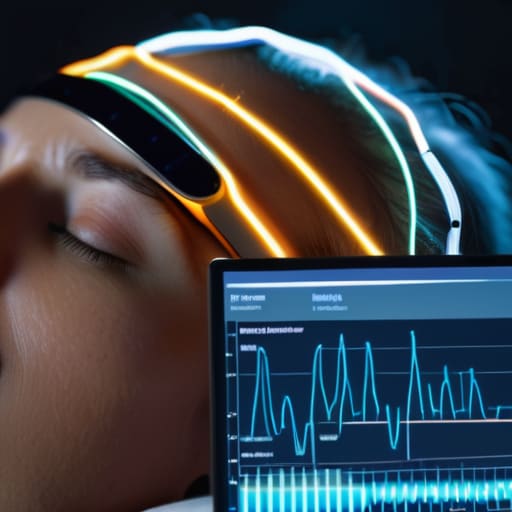
To understand why your wrist gadget is struggling, you have to look at the gold standard: polysomnography. In a clinical sleep lab, a technician isn’t just looking at your movement; they are measuring brain waves, eye movements, and muscle activity via electrodes stuck directly to your scalp. This is the only way to truly confirm when you’ve transitioned from light sleep into a deep state. When we talk about polysomnography vs consumer trackers, we are comparing a high-resolution medical map to a blurry, hand-drawn sketch.
Because your wearable relies on movement and pulse rather than brain activity, the sleep stage tracking error rates can be significant. Most devices use algorithms to guess your sleep cycles based on how still you are and your heart rate variability sleep analysis. It’s a clever bit of math, but it’s still an educated guess. If you are looking for clinical-grade REM sleep detection precision, you won’t find it in a piece of silicone and glass on your nightstand. Don’t let a “low REM” score on an app ruin your morning; the tech is a compass, not a GPS.
Why Most Wearable Sleep Technology Reliability Is Just Marketing Noise
The marketing behind these devices is incredibly effective because it conflates “data collection” with “data truth.” Companies love to throw around terms like biometric sensor accuracy to make you feel like you’re holding a medical-grade laboratory on your wrist. But there is a massive difference between a sensor successfully recording a pulse and a sensor correctly interpreting what that pulse means for your neurological state. Most of what you see in an app is a highly polished estimation, not a measurement.
When you look at the actual sleep stage tracking error rates, the picture gets even less glamorous. While these gadgets are decent at telling you when you’re awake or asleep, their REM sleep detection precision is often hit-or-miss at best. They are essentially using mathematical models to guess your brain activity based on movement and heart rate. It’s clever engineering, certainly, but it’s not a window into your soul. If you find yourself spiraling into anxiety because your ring says you had “poor recovery,” remember that you are reacting to a statistical guess, not a clinical fact.
The Error Rates of Sleep Stage Tracking You Should Watch
Here is the reality of the data on your wrist: while these devices are decent at telling you when you fell asleep and when you woke up, they are notoriously bad at telling you how you slept. When we look at sleep stage tracking error rates, the numbers are humbling. Most consumer devices struggle to differentiate between light sleep and the deeper, more restorative stages. You might wake up feeling refreshed, only to see a red bar on your app claiming you had “zero deep sleep.” This isn’t a medical crisis; it’s just a limitation of the hardware.
The real issue lies in REM sleep detection precision. Because wearables rely heavily on movement and heart rate variability sleep analysis to guess your state, they often miss the subtle neurological shifts that define true REM. If you are obsessing over the exact minute your brain entered a specific cycle, you are chasing ghosts. I tell my patients to stop looking at the granular breakdowns. Instead, look at the long-term trends over weeks, not the minute-by-minute fluctuations that are often just statistical noise.
Deciphering Rem Sleep Detection Precision Without Losing Your Mind
If you’ve ever woken up feeling like a zombie only to see your app report a “perfect” night of restorative REM, you’ve encountered the gap between data and reality. Here is the thing: REM sleep detection precision is the Achilles’ heel of almost every wrist-worn device. While these sensors are decent at catching when you are dead to the world, they struggle to distinguish the subtle neurological shifts that define REM. They rely heavily on movement and heart rate variability sleep analysis, but because your heart doesn’t always change its rhythm in a predictable way during every REM cycle, the device often just guesses.
I see people obsessing over these granular fluctuations, trying to “optimize” a metric that is essentially an educated estimate. When you look at the sleep stage tracking error rates in clinical literature, the discrepancy is glaring. Most of these gadgets are actually just tracking your stillness and your pulse, not your brain waves. My advice? Stop trying to hunt for the perfect REM score. If you feel rested, believe your body, not the unreliable math on your wrist.
Focusing on Heart Rate Variability Sleep Analysis Over Everything Else
If you’re going to obsess over a piece of plastic on your wrist, stop chasing the ghost of “perfect” sleep stages. As I mentioned earlier, the gap between polysomnography vs consumer trackers is a chasm that won’t be closed by a software update anytime soon. If you try to micromanage your REM cycles based on a consumer algorithm, you’re just inviting unnecessary anxiety. Instead, I want you to look at a much more stable, albeit less flashy, metric: Heart Rate Variability (HRV).
While sleep stage tracking error rates can be wildly inconsistent depending on how tightly you buckled your strap, HRV offers a more grounded window into your autonomic nervous system. It isn’t a magic crystal ball, but it is a reliable proxy for how your body is actually recovering from the day’s stressors. I don’t care if your watch thinks you spent forty minutes in “Light Sleep” when you were actually awake; I care if your HRV trend is dropping over a week. Focus on the long-term physiological signal rather than the granular, often incorrect, nightly breakdown.
How to Use Your Tracker Without Letting It Ruin Your Sleep
- Stop obsessing over sleep stages. Your watch might tell you that you had twenty minutes of REM, but it’s often just guessing based on movement; focus instead on whether you actually feel rested when you wake up.
- Treat Heart Rate Variability (HRV) as a general trend, not a daily verdict. A single low reading doesn’t mean you’re failing at life; it just means your nervous system is busy, so look at the weekly average instead.
- Ignore the “Sleep Score.” These numbers are arbitrary algorithms designed by engineers to keep you opening the app, not by clinicians to improve your health. A score of 72 is meaningless if you feel great.
- Use the data to find patterns, not to fix problems. If you notice your resting heart rate stays high after a late dinner or a glass of wine, that’s useful information; if you’re using it to stress about a “bad” night, it’s doing more harm than good.
- Check the hardware, not just the software. If your strap is loose or the sensor is dirty, the data is garbage. A tracker only works if it’s actually making consistent contact with your skin, which sounds obvious but is rarely the case.
The Bottom Line: What to Actually Pay Attention To
Stop obsessing over sleep stages like REM or Deep Sleep; these are the metrics where consumer tech fails most spectacularly and will only cause you unnecessary anxiety.
Treat your tracker as a trend monitor, not a medical diagnostic tool; use it to spot long-term patterns in your recovery, not to judge how you felt on a single Tuesday night.
Prioritize Heart Rate Variability (HRV) and resting heart rate over everything else, as these metrics are significantly more reliable and offer a much clearer picture of your physiological strain.
The Data Delusion
Stop obsessing over whether your watch says you hit ‘Deep Sleep’ at 3:00 AM; most of those metrics are just educated guesses wrapped in shiny plastic. If you want to actually improve your rest, stop chasing the digital ghost of a perfect sleep score and start looking at the boring, consistent trends in your heart rate variability.
Marisol Trevino-Baird
The Bottom Line
We have spent a lot of time dissecting the technical gaps between a clinical sleep lab and the gadget on your wrist. The reality is that while your tracker is decent at spotting when you are awake versus asleep, its ability to pinpoint specific stages like REM or deep sleep is often little more than educated guesswork. If you find yourself obsessing over a sudden drop in your sleep scores, remember that the data is frequently noisy and prone to error. Instead of chasing every fluctuating metric, I suggest you focus on the trends in your heart rate variability and your general waking alertness. The numbers are a guide, not a gospel.
At the end of the day, the most sophisticated wearable in the world cannot replace the basic, unglamorous fundamentals of good hygiene. You can buy every sensor on the market, but they won’t fix a late-night scrolling habit or a caffeine dependency. Stop looking for a digital magic wand to tell you how you feel; start listening to your own body. The most effective way to improve your sleep isn’t found in a new app update, but in the boring, consistent habits you implement when the screen is turned off. Trust your biology more than your battery life.